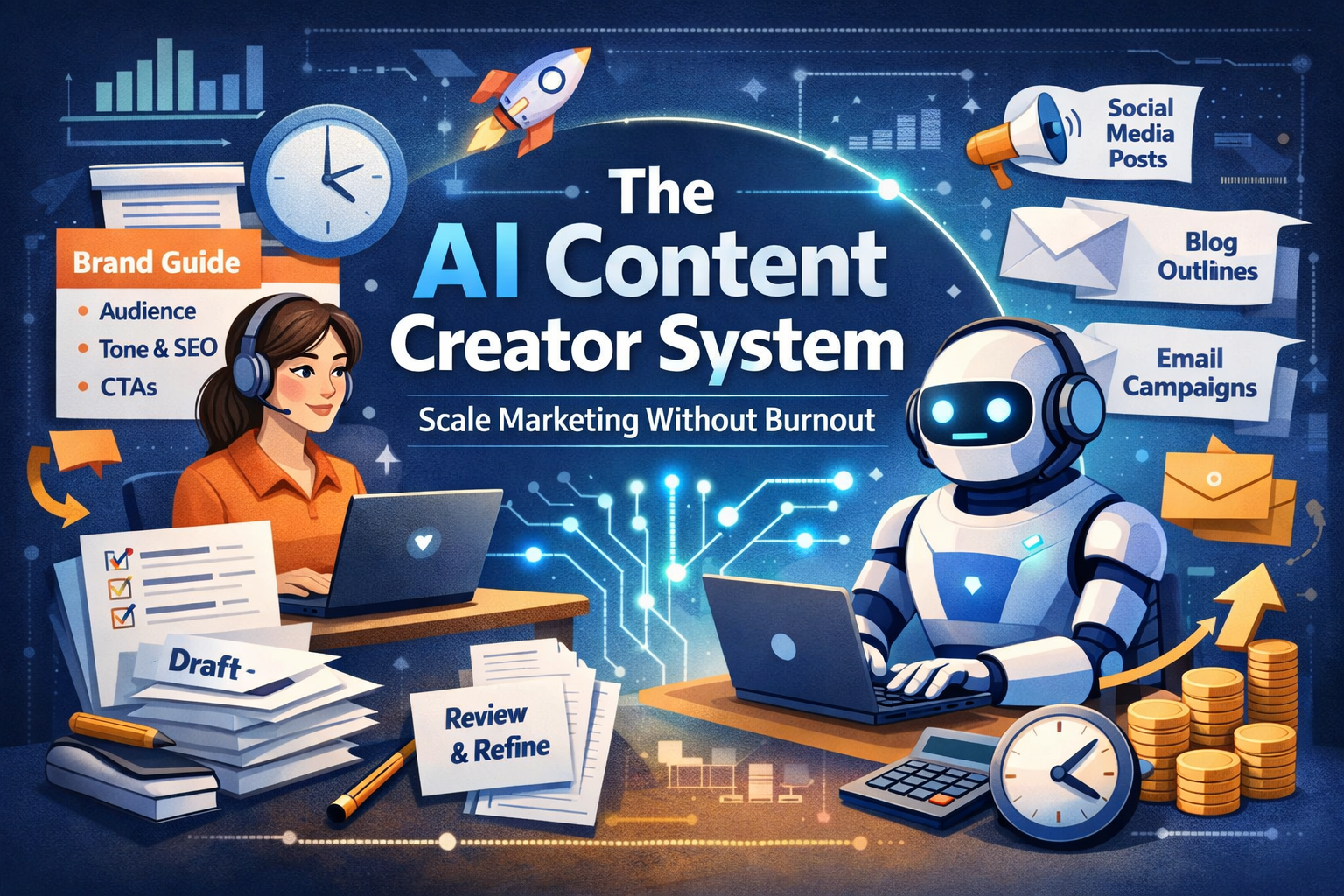
The AI Content Creator System: How to Scale Marketing Without Burnout
From Bottleneck to Breakthrough: How to Systemize Content Creation with AI

Organizations frequently struggle to maintain a consistent marketing presence. Not because they lack ideas—but because manual content creation consumes an enormous amount of time and energy.
The result?
- Bottlenecks in the content pipeline.
- Delayed campaign launches.
- Missed market opportunities.
- Declining audience engagement.
- Reduced brand visibility.
When content production depends entirely on human drafting from scratch, growth becomes limited by available hours. And as we all know, hours are expensive.
Let’s break down the real cost of manual creation—and explore a scalable solution.
The Hidden Cost of Manual Content Creation
Most companies account for the visible time spent drafting content. However, very few account for the hidden costs that silently drain budgets and team morale.
1. Opportunity Cost
Highly skilled marketing professionals often spend hours on repetitive drafting tasks instead of high-impact work like:
- Strategic campaign planning.
- Performance analytics.
- Funnel optimization.
- Revenue-generating initiatives.
Every hour spent writing first drafts is an hour not spent on strategic growth.
2. Burnout and Quality Decline
Scaling manual content production inevitably leads to creative fatigue. Over time, you’ll notice:
- Output slows down.
- Quality drops significantly.
- Creative thinking weakens.
Burned-out creators don’t produce high-impact work; they produce average work that gets lost in the noise.
3. Inconsistent Brand Voice
When multiple writers—or rushed freelancers—produce content without a strict system:
- Tone becomes inconsistent across platforms.
- Core messaging drifts away from company goals.
- Brand identity weakens.
Consistency builds authority. Inconsistency erodes it.
4. Delayed Campaign Execution
Content delays push back product launches, promotions, and marketing campaigns. This leads to:
- Lost revenue opportunities.
- Reduced market responsiveness.
- Slower competitive positioning.
5. Rising Operational Costs
To keep up with demand, companies often react by hiring more bodies. This usually means:
- Hiring junior writers (who need management).
- Outsourcing to freelancers (quality control issues).
- Increasing management overhead.
All of these "solutions" increase operational complexity and costs without guaranteeing better output.
The Solution: The AI Content Creator System
The goal isn't to replace your talented marketers. Instead, this system replaces the first 80% of the drafting work—the heavy lifting that consumes so much time.
It handles the heavy lifting for:
- Social media posts.
- Blog outlines.
- Email marketing copy.
- Video scripts.
Think of it as a highly efficient, always-on junior content creator that works instantly—while your human experts remain responsible for strategy, refinement, and final approval.
Tools Required
To build this system effectively, you need three core tools, each serving a specific purpose:
- ChatGPT Plus: Used for brainstorming, complex outlining, first-draft generation, and structured content ideation.
- Jasper.ai (Boss Mode + Brand Voice): Used for long-form structured content, maintaining tonal consistency, and expanding outlines into full articles.
- Copy.ai: Used for high-volume short-form content, social media variations, ad copy generation, and creating A/B testing variations.
Each tool has a defined role in the workflow, ensuring you use the right hammer for the right nail.
Step-by-Step Setup Guide
Ready to build your system? Follow these steps to ensure success.
Step 1: Create a Centralized Brand Guide (Non-Negotiable)
In Google Docs or Notion, create a one-page AI Content Style Guide. This document is the "source of truth" for the AI. It must include:
- Target Audience Persona: Define your ideal customer in 3 bullet points (Job title, Primary goal, Main pain point).
- Example: Owner of a 5-person plumbing company / Wants more local leads / Doesn’t understand digital marketing.
- Brand Voice & Tone: List 3–5 tone descriptors.
- Example: Authoritative, Helpful, Concise, Professional, Slightly informal.
- Key Messaging Pillars: Define 3–4 recurring themes.
- Example: Cost Savings, Time Efficiency, Scalable Growth.
- Core SEO Keywords: List 10–15 primary and secondary keywords.
- CTA Library: Standardize your calls to action (e.g., "Book a demo," "Download the guide").
Without this document, AI output will lack consistency and require heavy editing.
Step 2: Configure Tool-Specific Brand Settings
You must train the tools on your brand voice.
- Jasper.ai: Use the "Brand Voice" feature. Upload your "About Us" page, a few high-performing blog posts, and your new Style Guide. This trains Jasper to mimic your tone.
- ChatGPT Plus: Use Custom Instructions.
- Box 1: Paste your Brand Guide.
- Box 2: Add instructions like: "Respond in the tone of [Your Tone Words]. Always reference our key messaging pillars. Keep responses concise and focused on our target audience: [Your Persona]."
Now, every output aligns automatically.
Step 3: Develop a Prompt Library
Create a shared document titled "AI Prompt Library." Organize prompts by category so your team isn't reinventing the wheel every time:
- Blog outlines
- LinkedIn posts
- Email newsletters
- Ad copy
- Landing pages
This becomes your team’s single source of truth for generation.
Step 4: Establish the Generate–Review–Refine Workflow
This is the most critical step to protect your brand.
- Step A: Generate: A team member selects a structured prompt and generates content using the designated tool.
- Step B: Review: The output is pasted into Google Docs and shared with a human editor. The editor reviews for Accuracy, Brand alignment, and Strategic clarity. All edits are made in "Suggesting" mode.
- Step C: Refine & Publish: The original team member finalizes the content based on feedback and schedules it.
This two-person system prevents errors and protects brand credibility.
The Automation Flow: A 5-Stage System
The AI Content Creator System operates sequentially to maximize efficiency:
- Brief Creation: A standardized brief defines the target audience, primary keyword, key message, and desired CTA.
- Ideation & Outlining (ChatGPT Plus): Generate title options, angles, and structured outlines. The team selects the strongest outline.
- Drafting (Jasper.ai Boss Mode): Expand the approved outline into long-form content. The Brand Voice feature ensures consistency.
- Variant Generation (Copy.ai): Repurpose the core asset by creating social posts, ad copy variations, and promotional emails (5–10 variations per asset).
- Human Review & Finalization: All assets are reviewed against the original brief. Approved content is scheduled for publication.
Expected ROI
Investing in a system like this pays for itself almost immediately.
- Time Savings: Initial drafting time reduces from 10 hours per week to just 2 hours per week. That’s 8 hours saved weekly.
- Direct Cost Savings: At an average loaded cost of $40/hour, that’s $320 per week, or $16,640 per year in reclaimed labor.
- Software Costs:
- ChatGPT Plus: ~$240/year
- Jasper.ai: ~$468/year
- Copy.ai: ~$432/year
- Total: ~$1,140 per year
Net Annual ROI: $16,640 – $1,140 = ~$15,500 net savings
Beyond cost savings, the Productivity ROI is staggering. Content capacity increases by 400%. Instead of producing one major content piece per week, you can produce four—without hiring additional staff.
Common Mistakes to Avoid
Here are the pitfalls we see most companies fall into when adopting AI:
- Mistake #1: Publishing Unedited AI Output. AI content must never be published directly. Enforce the Generate–Review–Refine workflow strictly.
- Mistake #2: Using Vague Prompts. "Write a blog about marketing" produces generic, useless output. Always use structured, multi-part prompts.
- Mistake #3: Ignoring Brand Voice Configuration. Unconfigured AI sounds generic and robotic. Set your brand tone before generating content.
- Mistake #4: Forgetting SEO Integration. Every web article must include a primary keyword and follow structured SEO formatting (headings, meta descriptions, etc.).
- Mistake #5: Setting and Forgetting. Prompts must evolve. Schedule quarterly reviews of your Prompt Library to refine performance based on what’s working.
Final Thoughts
The problem facing modern marketing teams isn’t content demand.
It’s content production inefficiency.
By systemizing drafting with AI—while maintaining human oversight—organizations can finally break the bottleneck. They can:
- Reduce operational costs.
- Increase output dramatically.
- Maintain brand consistency.
- Accelerate campaign execution.
- Unlock scalable marketing growth.
The future of marketing isn’t manual. It’s augmented.
And the companies that systemize it first will be the ones who win.